
Site Equipment & PPE
Werner 7160618 Fibreglass Step Ladder (6 Tread)
Fibreglass step ladder with 6 treads, fibreglass stiles and 150kg load rating.
Werner

Work out how much gutter, how many downpipes and how many fittings a job needs, based on the total run length and roof area.
40m² per downpipe is a commonly used starting figure for a standard round downpipe — check the rainfall capacity stated for your specific gutter and downpipe system, especially on a larger or complex roof.
Gutter lengths needed is the total run divided by your chosen stock length, rounded up. Brackets are spaced along that same run at your chosen centres, with one extra added to cover both ends. Corner fittings match the number of corners you enter directly.
Unions are worked out as whatever joints are needed beyond one length per straight section between corners - in other words, the extra pieces left over once each corner has "used up" one length either side of it. This is an approximation that assumes your run divides reasonably evenly between corners; if one section is much longer than the others, check that section on its own.
Downpipes needed is the roof's plan area divided by the roof area figure you've set per downpipe, rounded up.
By dividing the roof's plan area by how much roof area a single downpipe can drain, then rounding up. That capacity figure varies by gutter profile, downpipe diameter and the rainfall intensity assumptions used, so treat the default as a reasonable starting point and check the manufacturer's own rainfall capacity table for anything beyond a straightforward small house roof.
Guttering needs a slight downward slope toward each downpipe outlet, typically around 1:350 to 1:600, so water actually runs off rather than sitting and overflowing. It's subtle enough that a spirit level with a fall gauge, or simple string-line and tape measure method, is normally used rather than trying to judge it by eye.
No. A corner fitting joins two lengths of gutter at an angle and does that joining job itself, so it replaces what would otherwise be a straight union at that point. Straight unions are only needed where two lengths join in a straight run between corners or outlets.
A stop end caps off an open end of guttering that isn't joined to anything else - typically the two ends of a run that doesn't form a complete loop around the building, such as a lean-to or a single elevation being replaced on its own.
Fibreglass step ladder with 6 treads, fibreglass stiles and 150kg load rating.
Werner
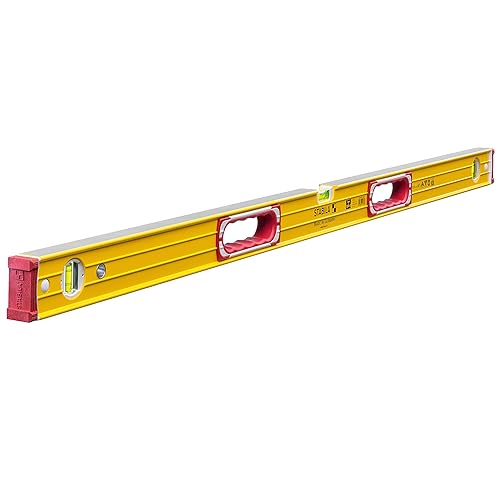
A 3-vial spirit level with vials locked into the body to resist movement, used by bricklayers, joiners and tilers. Any level can be knocked out of true by a hard drop, so check it.
Stabila

Compact 18V XR brushless combi drill with two-speed gearbox and 70Nm torque, designed for trade professionals.
DeWalt

8m tape measure with a 32mm wide blade, Mylar coating, Blade Armor on the first part of the blade and metric and imperial markings.
Stanley