Tools
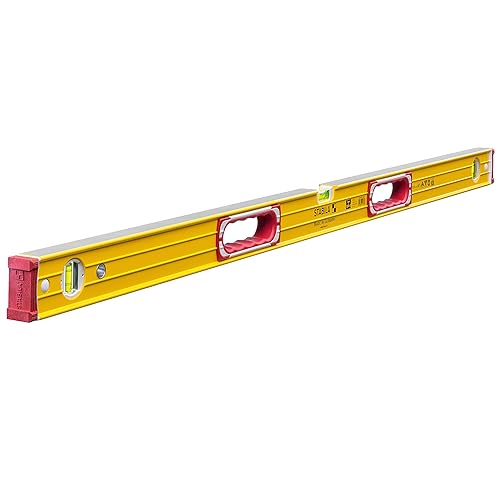
Stabila 196-2 Spirit Level (120cm)
A 3-vial spirit level with vials locked into the body to resist movement, used by bricklayers, joiners and tilers. Any level can be knocked out of true by a hard drop, so check it.
Stabila

Work out how many tiles you need for a floor or wall, plus the adhesive and grout to go with them, based on your area and tile size.
Tiles needed is the area divided by the area of one tile, with your chosen wastage allowance added on top for cuts, breakages and pattern-matching, then rounded up to a whole tile - and to a whole box, if you've entered how many tiles come in a box.
Adhesive coverage is estimated from the tile size, since larger tiles need a deeper adhesive bed and a bigger trowel notch: roughly 3.5kg/m² for small tiles, 5.5kg/m² for mid-size tiles, and 8kg/m² for large format tiles. This changes automatically as you enter a tile size, though it's always worth checking the exact coverage stated on the adhesive bag for the trowel size you're actually using.
Grout is calculated from the real geometry of the joints: the total length of grout line per square metre depends on the tile's length and width, and the volume of grout in that line depends on the joint width and the tile's thickness (which sets how deep the joint is). That volume is converted to weight using a typical grout density of 1.6kg per litre. This is the same method used by tile adhesive and grout manufacturers on their own coverage calculators.
Add 10% on top of the exact area for a straightforward grid layout. Increase that to 15% for a diagonal layout, and 20% or more for a complex pattern, a small or awkwardly shaped room, or if it is your first time tiling and mistakes are more likely.
Adhesive coverage depends mainly on the notched trowel size used, which in turn depends on the tile size: small and mosaic tiles typically use a 6mm notch at around 3.5kg/m², mid-size tiles a 10mm notch at around 5.5kg/m², and large format tiles a 12mm-plus notch (often with back-buttering) at around 8kg/m². These are solid starting estimates, but the adhesive bag itself will state its exact coverage for the trowel size you're using.
Grout fills the gap between tiles both across the joint (the width you can see) and down through the depth of the tile, so the volume of grout needed depends on both. Tile thickness is normally printed on the box - for a typical ceramic floor tile it's usually 8-10mm, and for a wall tile more like 6-8mm.
Often yes. Wall adhesive needs enough initial grab to hold tiles in place without slipping before it cures, while floor adhesive is formulated for a different set of stresses, and larger or heavier tiles may need a specific rated adhesive. Check the adhesive is rated for both your tile type and the surface (wall or floor) before buying.
A 3-vial spirit level with vials locked into the body to resist movement, used by bricklayers, joiners and tilers. Any level can be knocked out of true by a hard drop, so check it.
Stabila

1200mm semi-flexible plastering rule with a plastic blade and aluminium handle for flattening skim coats on large walls and ceilings.
OX Tools

Silicone sealant with anti-mould protection, waterproof once cured, for kitchen and bathroom sealing around baths, showers, sinks and worktops.
UniBond
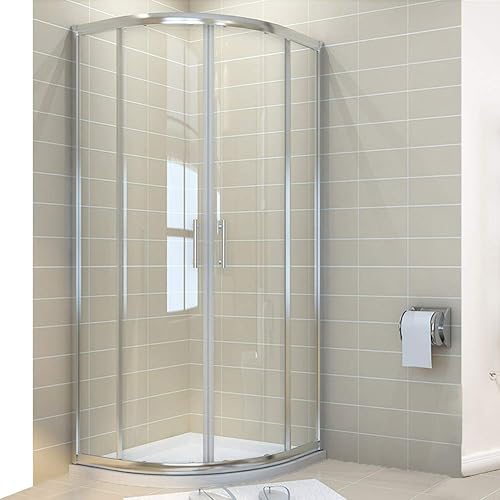
900mm quadrant shower enclosure with 6mm tempered glass, sliding doors, and chrome frame, designed for corner installation in UK bathrooms.
ELEGANT