
Electrical & Lighting
Aurora Enlite Fixed Fire Rated GU10 Downlight EN-FD101SN Satin Nickel
Fixed fire rated GU10 downlight in satin nickel finish for domestic ceiling installations, maintaining fire integrity for up to 90 minutes.
Aurora Enlite


Professional 3-in-1 wall scanner detecting live cables, metal pipes and wooden studs up to 120mm deep.
The Bosch GMS 120 is the go-to wall scanner for electricians, plumbers and general builders who need to know what is behind a wall before drilling. Its three detection modes cover live cables, metal pipes and wooden studs, while the illuminated ring provides instant traffic-light feedback — green for safe, red for danger.
The Bosch GMS 120 is one of those tools that every trade van should carry. A few seconds of scanning before drilling can prevent cutting through a mains cable, puncturing a water pipe, or missing a stud entirely. The consequences of not scanning — a live cable, a flooded ceiling, a failed fixing — far outweigh the cost of the tool.
The drywall mode detects wooden studs and joists behind plasterboard and is the correct mode when fixing into stud partition walls. The metal mode picks up ferrous and non-ferrous metals including copper pipes, steel beams, and rebar — useful on masonry walls where pipes may be buried in the plaster. The live cable mode detects energised wiring up to 50mm deep. Switching between modes is a single button press; for a thorough pre-drill check, running all three modes in sequence takes under a minute.
The illuminated ring around the display changes colour as you scan: green when the area is clear, yellow when approaching a detected object, and red when directly over it. This is far more intuitive than numerical readouts, particularly when working overhead, in dim conditions, or one-handed. The centre-finding function identifies the mid-point of a stud, giving you the precise drill position for a secure fixing.
The GMS 120 requires calibration on each new wall surface — hold the tool against the clean wall area and press the calibration button. This sets the baseline for that specific substrate. Like all wall scanners, it is a detection aid rather than an absolute guarantee: deep cables, complex wall construction, and overlapping services can all affect readings. In high-risk situations — chasing for new circuits or drilling next to known services — a scan should be supplemented with a visual check and a careful pilot hole.
The Bosch GMS 120 is the professional wall scanner that tradespeople across all disciplines rely on. Its three detection modes, traffic light feedback, and centre-finding accuracy make it an essential safety tool for anyone who drills into walls regularly.
Against budget wall scanners costing a fraction of the price, the GMS 120’s main advantage is reliability and depth performance — cheap scanners often struggle with false positives or fail to detect cables at any meaningful depth, which defeats the purpose of using one at all. Against dedicated cable-only detectors (often called “cable avoidance tools” or CAT scanners) used more heavily in groundworks, the GMS 120 is designed for wall and ceiling scanning in buildings rather than underground service detection, and shouldn’t be confused with the specialist equipment used before excavation work. Within Bosch’s own detector range, the GMS 120 sits as the solid mid-tier option — a step up from basic stud finders that only detect wood, and a step below the higher-end D-tect range that adds features like object visualisation and Bluetooth connectivity for professionals who need more detailed wall mapping.
Does this detect cables that aren’t live? No — the live cable detection mode specifically detects energised (live) wiring by sensing the electromagnetic field it produces. A cable that’s switched off at the consumer unit will not register in cable detection mode, which is why a scan should never be treated as a substitute for isolating circuits before chasing walls.
Why does it need calibrating on every wall? Different wall materials — plasterboard, brick, block, plaster over lath — have different densities and properties that affect the scanner’s baseline reading. Calibrating on a known-clear section of the specific wall being worked on ensures the detection modes are reading against an accurate baseline for that surface.
Is it reliable enough to drill without any other checks? It’s a genuinely useful and generally reliable detection aid, but no wall scanner offers an absolute guarantee, particularly with cables or pipes buried more deeply than the stated detection range. For anything beyond routine fixing, especially near known services or in older properties with unpredictable wiring history, supplementing a scan with a visual check and cautious drilling technique remains good practice.
| Detection Depth (Ferrous Metal) | 120mm |
|---|---|
| Detection Depth (Non-Ferrous Metal) | 80mm |
| Detection Depth (Live Cable) | 50mm |
| Detection Depth (Wood) | 38mm |
| Modes | Drywall, Metal, Live Cable |
| Power | 1x 9V battery |
| Weight | 270g |
Fixed fire rated GU10 downlight in satin nickel finish for domestic ceiling installations, maintaining fire integrity for up to 90 minutes.
Aurora Enlite

13A double switched socket in brushed steel with grey inserts, part of the BG Nexus Metal range for decorative wiring accessories.
BG Electrical
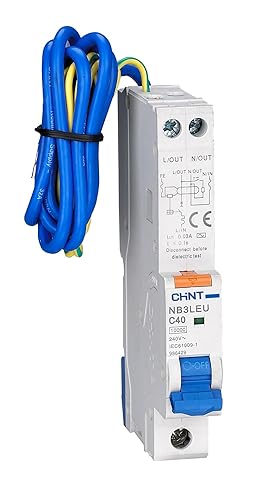
Combined MCB and RCD in a single module, 16A Type B with 30mA Type A earth leakage protection, 10kA breaking capacity for Amendment 3 consumer units.
Chint