Impact driver and impact wrench are two of the most confused tool names in the trade, and picking the wrong one usually means stripped fixings, an underpowered attempt at a seized wheel nut, or money spent on a tool that can’t do the job it was bought for. They look similar, both deliver rotational force in sharp bursts, and both get called “impact guns” on site. But they’re built around different drive systems and different torque ranges, and each is the right choice for a specific kind of work.
Impact Driver vs Impact Wrench: The Core Difference
An impact driver is built to drive screws and fixings fast, using a 1/4 inch hex bit holder and moderate torque delivered in a rotational impact pattern. An impact wrench is built to turn nuts and bolts under high torque, using a square drive and a heavier directional impact mechanism.
| Impact Driver | Impact Wrench | |
|---|---|---|
| Drive type | 1/4” hex collet | Square drive (1/2”, 3/4”, 1”) |
| Typical torque | 100-220Nm | 300-1,500Nm+ |
| Primary use | Screws, fixings, general driving | Nuts, bolts, wheel nuts |
| Impact mechanism | Rotational (spring-loaded hammer) | Directional (twin-hammer or single-hammer) |
| Size/weight | Compact, light | Larger and heavier, scales with torque class |
| Typical trade user | Every trade, daily use | Automotive, tyre fitting, structural steel, scaffolding |
How an Impact Driver Works
An impact driver spins continuously under light resistance, then engages a spring-loaded rotational impact mechanism once resistance builds, delivering short bursts of rotational force rather than constant twisting pressure. That’s what stops it from camming out or stripping a screw head the way a standard drill/driver can under heavy load, and it’s why impact drivers can drive long screws into dense timber without stalling.
The 1/4 inch hex bit holder accepts standard hex-shank driver bits directly, with no chuck to tighten, which is part of why they’re faster to use for repetitive fixing work than a combi drill in screwdriving mode.
How an Impact Wrench Works
An impact wrench uses the same basic principle, rotation combined with a hammering impact, but at a different scale and through a different mechanism. Most impact wrenches use a twin-hammer or single-hammer mechanism that delivers a heavier, more directional strike, built to overcome the much higher resistance of a torqued or seized nut rather than to drive a fixing.
The square drive accepts sockets rather than hex bits, exactly as you’d find on a socket set, in 1/2 inch (the standard for trade and light automotive use), 3/4 inch, or 1 inch for heavy plant and industrial applications. Because the torque output is so much higher, an impact wrench can undo a nut that’s corroded or over-tightened well beyond what an impact driver, or a hand tool, could shift.
When You Need an Impact Driver
For most trades, the impact driver is the tool that comes out of the bag more than any other. It covers:
- Decking and timber fixing, including long screws that would stall a standard drill
- First and second fix carpentry, stud walls, joists, general construction screws
- Plasterboard and drywall screws at volume
- Cabinet and fitted furniture assembly
- Any job that’s mostly screws rather than nuts and bolts
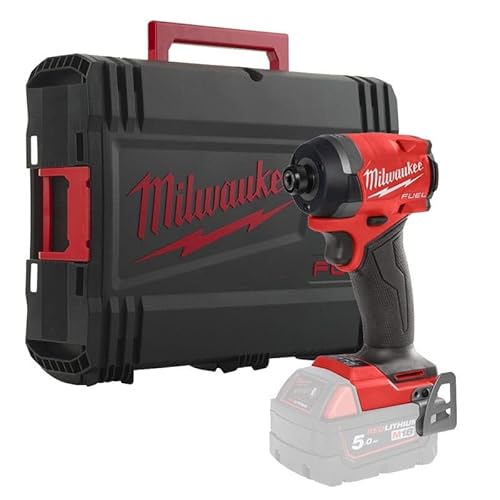
If you already own a combi drill, an impact driver is usually the next tool added, since between them they cover drilling, hammer drilling, and all general screwdriving. Milwaukee’s M18 range covers this ground well; see the Milwaukee M18 FID3 impact driver for a current example of what a compact, high-spec driver looks like in practice.
When You Need an Impact Wrench
An impact wrench is a more specialist tool, reached for when the job specifically involves nuts and bolts under real torque:
- Wheel nuts on vans and light commercial vehicles, always followed up with a torque wrench to the correct spec
- Structural steelwork, where bolted connections need to be run up quickly before final torquing
- Scaffold fixings and heavy plant maintenance
- Automotive and tyre-fitting work, where speed matters and torque requirements are well above what a driver can deliver
- Any seized or corroded fixing that a hand ratchet can’t shift
Buy the drive size to match the work. 1/2 inch covers the vast majority of trade and light automotive use; only move up to 3/4 inch or 1 inch if you’re regularly working with heavy plant or industrial fixings, since the tools get significantly larger and heavier at each step up.
Do You Need Both?
For most tradespeople who do any mix of general fixing and automotive, structural, or scaffold work, the honest answer is yes. An impact driver won’t shift a torqued wheel nut, and an impact wrench is overkill and awkward for driving a box of decking screws. The same logic applies here as when deciding between an SDS drill and a combi drill: once you’re doing enough of both types of work to notice the wrong tool slowing you down, it’s worth owning both rather than compromising on one.
Choosing a Platform
If you’re buying into either tool for the first time, buy into whichever cordless platform you already carry batteries for. Committing early avoids ending up with two incompatible battery systems and duplicate chargers. See our guide to choosing a cordless power tool platform for a full comparison of DeWalt 18V XR, Makita LXT, Milwaukee M18 and Bosch Professional if you’re starting from scratch.