
Landscaping & Outdoors
Treated Timber Sleepers 100x200x2400mm (10 Pack)
Pack of 10 pressure-treated softwood timber sleepers measuring 100x200x2400mm, suitable for garden borders, retaining walls, raised beds, and landscaping features.
Generic

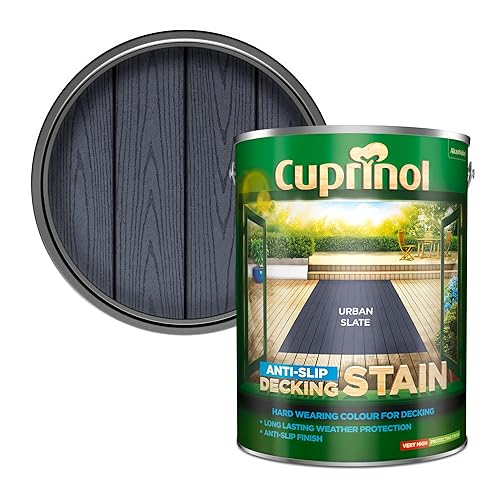
5-litre anti-slip decking stain in Urban Slate with anti-slip microbeads for grip underfoot and algicide protection against green growth.
The Cuprinol Anti-Slip Decking Stain colours and protects decking and contains anti-slip microbeads to add grip to the surface. An integrated algicide inhibits the growth of green algae and mould on the dried film surface. Urban Slate is a grey shade.
Timber decking can become slippery when wet or when algae takes hold. Cuprinol’s Anti-Slip Decking Stain combines colour and protection with anti-slip microbeads and an algicide.
The water-based formula can be applied with a brush, roller or pad applicator. Retailer listings give drying times of between 2 and 6 hours depending on conditions, and two to three coats, so check the tin for the number of coats and the recoat time. Urban Slate is a grey shade with a matt finish. The final appearance will vary depending on the timber species and how weathered the deck is.
The anti-slip microbeads are mixed into the stain to add grip to the surface. The algicide within the formulation helps slow the regrowth of green algae and mould on the stained surface, though it will not remove the need for occasional deck cleaning.
Cuprinol Anti-Slip Decking Stain combines a colour refresh with anti-slip microbeads and an algicide. Retailer listings give about 8m² per litre, so a 5L tin covers roughly 40m² per coat. For best results, apply to clean, dry timber and follow the drying times on the tin.
Cuprinol Anti-Slip Decking Stain is a water-based, low VOC stain that contains anti-slip microbeads. Retailers describe a matt finish, and an algicide in the stain that helps protect the dry film from algae and mould. You apply it with a brush or roller. Coverage is about 8m2 per litre, although some listings give higher, so check the tin. Drying and recoat time is 2 to 6 hours, depending on the weather and the surface.
The table compares the usual ways of finishing and caring for decking.
| Option | What it is | What to weigh up |
|---|---|---|
| Anti-slip decking stain | Colour plus microbeads for grip | Reduces slipping but does not remove the risk |
| Decking oil | Oil-based finish for timber | Check the tin for preparation and recoat times |
| Decking paint | A painted finish | Check the tin for preparation and recoat times |
| Anti-slip strips or tape | Clear strips fixed onto boards | Applied to the surface in strips |
| Cleaning only | Removes algae and dirt | Does not add a finish |
Preparation matters as much as the product. The surface must be dry and free from dirt. Remove existing algae, lichen, moss and fungus first. Wood that has been stained or painted before must be stripped back to bare wood. Follow the instructions on the tin.
For other garden timber jobs, see the treated timber sleepers and the Ronseal Fence Life Plus.
Where decking is shaded or damp, algae and moss build up faster, and they make boards slippery whatever finish is on them. The stain contains an algicide that helps protect the dry film from algae and mould, but regular sweeping and cleaning still matter. Anti-slip microbeads add grip to the surface, so stir the tin thoroughly before use and from time to time while you work, as the tin advises, so the beads stay spread through the stain.
Apply the stain evenly along the grain with a brush or roller, avoiding overlaps. Test a small area first to check the colour on your own timber. Allow the finish to cure fully before heavy use, and check the tin for the time.
How do I prepare decking before staining? Clean the boards, then remove algae, lichen, moss and fungus. Let the timber dry completely. If the wood has an old stain or paint, strip it back to bare wood. Follow the tin for any sanding or brightening steps.
How many coats and how long between them? Retailers suggest 2 to 3 coats, but check the tin for the number of coats. Drying and recoat time is 2 to 6 hours depending on weather and surface. Allow the stain to cure fully before heavy use and check the tin for how long.
Does anti-slip stain make decking safe in ice? No. The microbeads reduce slipping, but they do not remove it, and ice, frost and wet algae are still hazards. Sweep leaves and clean off algae regularly, and treat icy boards with care.
Can I stain over old paint? Only if the old coating is sound and the tin allows it. The product guidance says previously stained or painted wood needs stripping back to bare wood. Check the tin before you start.
What weather do I need? Choose a dry spell with a dry forecast, and avoid damp or frosty days. The maker’s guidance is not to apply below 5°C, in damp conditions or if rain is due before the stain has dried. The boards must be dry before you start, so allow time after rain.
| Volume | 5 litres |
|---|---|
| Colour | Urban Slate |
| Coverage | About 8m² per litre (retailer listings; check the tin) |
| Finish | Matt |
| Drying Time | Retailers give 2 to 6 hours; check the tin |
| Coats Required | Check the tin |
| Base | Water-based |
Pack of 10 pressure-treated softwood timber sleepers measuring 100x200x2400mm, suitable for garden borders, retaining walls, raised beds, and landscaping features.
Generic

Shed and fence treatment, Ronseal states up to 5 years of protection. Water-based, quick drying, and available in multiple colours.
Ronseal

Cordless hedge trimmer with 550mm blade length, 20mm cutting capacity, and 18V battery for domestic hedging.
Bosch

Compact 3.6V cordless shrub and grass shear set with interchangeable 120mm shrub blade and 80mm grass blade, weighing just 550g.
Bosch

Cordless lawnmower with 37cm cutting width, dual 18V battery system, and 40-litre grass box for medium-sized lawns up to 500m².
Bosch