
Tools
DeWalt DCD796 18V Brushless Combi Drill
Compact 18V XR brushless combi drill with two-speed gearbox and 70Nm torque, designed for trade professionals.
DeWalt

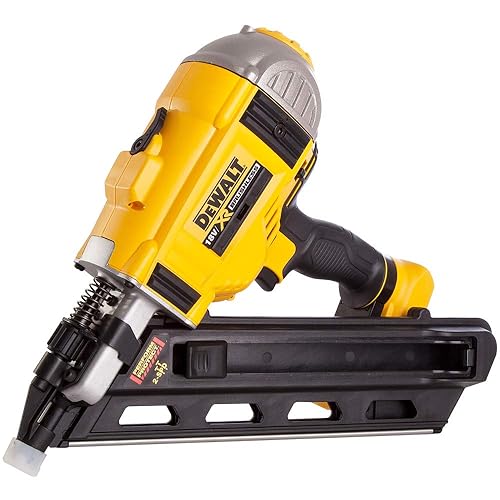
Cordless 18V first fix framing nailer with dual speed for 50-90mm nails, brushless motor, and tool-free depth adjustment.
The DeWalt DCN692N is a cordless first fix framing nailer designed for timber frame construction, roofing battens, and general carpentry.
The DCN692N is DeWalt’s cordless first fix nailer. It drives framing nails up to 90mm without a compressor, air line or gas cartridge, which simplifies set-up for timber frame construction, roofing and first fix carpentry.
The dual-speed switch selects between a higher setting for longer nails (75–90mm) and a lower setting for shorter nails (50–64mm). Matching the speed to the nail length helps avoid driving shorter nails too deep. DeWalt’s own guidance on battery use with each setting is in the manual.
Sequential mode (press the contact foot, then pull the trigger) drives one nail per trigger pull, giving control over each fixing position. Bump fire mode allows continuous nailing by holding the trigger and bouncing the contact foot against each fixing point, which suits repetitive work such as roofing battens and studwork. Choose the mode that suits the task and follow the safety instructions for each.
Retailers list the DCN692N as taking framing nails of 50–90mm in 30 to 34 degree strips, with clipped head or offset round head nails on paper tape or wire weld collation. Check the manual for the exact nail types before buying strips. The 55-nail magazine reduces reloading on high-volume tasks.
This is a heavy tool, and more so with a battery fitted. Retailer listings give different bare weights, so check the maker’s data if weight matters for sustained overhead nailing.
The DCN692N removes the need for a compressor and air lines on site, with two speed settings, sequential and bump fire modes and a 55-nail magazine. Check the nail specification and the weight with a battery fitted before buying.
The DeWalt DCN692 is a cordless framing nailer on the 18V XR platform, supplied as a bare unit, so the battery and charger are bought separately. It takes nails from 50 to 90mm and the magazine holds up to 55 nails. It has a brushless motor, two speed settings to suit the nail length, a tool-free switch between sequential and bump modes, thumbwheel depth adjustment and a dry-fire lockout. Retailers list the magazine angle as 30 to 34 degrees, and the nailer accepts paper-tape or wire-weld collated framing nails in clipped head and offset round head styles. Always match the nails to the magazine angle and to the manufacturer’s nail list.
The table sets this type of nailer beside the other ways of fixing timber framing.
| Method | What it involves | What to weigh up |
|---|---|---|
| Cordless framing nailer such as this one | Battery powered, no hose and no fuel cell | Battery and charger are separate on the bare unit |
| Pneumatic framing nailer | Needs a compressor and an air hose | Hose and compressor to set up and move around |
| Gas-powered framing nailer | Uses a fuel cell | Fuel cells are a separate consumable |
| Finish or second-fix nailer | Drives smaller nails for trim and joinery | A different tool for a different stage of the job |
| Hammer and hand nailing | No power source at all | Every nail is driven by hand |
A framing nailer belongs to first fix work: studwork, joists, rafters, timber frame panels and similar structural carpentry. Second-fix work such as architraves and skirting needs a finish nailer instead. If you already own DeWalt 18V XR batteries, the bare unit uses the same platform, so check which of your existing batteries and chargers you can share.
What is the difference between sequential and bump fire? In sequential mode you place the nose against the timber first and then pull the trigger for each nail. In bump mode you can hold the trigger and bump the nose against the work to fire each nail. Bump mode is used for repetitive nailing across a surface, while sequential mode places each nail deliberately. Choose the mode that suits the task, read the manual and wear the right PPE.
What size and type of nail does it take? Nails from 50 to 90mm, collated in paper tape or wire weld, in clipped head and offset round head styles. Retailers give the magazine angle as 30 to 34 degrees, so check the nail pack against the angle and the manufacturer’s nail list before you buy.
Can it nail hardwood? Retailer wording says it drives 90mm ring-shank nails into softwood and 63mm into hardwood. Timber varies a lot, so test on an offcut first and adjust the depth with the thumbwheel until the nail sits where you want it.
What does the dry-fire lockout do? It stops the tool firing when the nails run out, so the driver does not strike the timber with no nail in front of it. Reload before carrying on.
What safety steps should I take? Wear eye and ear protection and keep your free hand clear of the nose and the line of fire. Take the battery out before you clear a jam or change the nails. Follow the manufacturer’s instructions and use a competent person where required.
| Voltage | 18V |
|---|---|
| Nail Length Range | 50-90mm |
| Magazine Capacity | 55 nails |
| Weight (bare) | Check the maker's data |
Compact 18V XR brushless combi drill with two-speed gearbox and 70Nm torque, designed for trade professionals.
DeWalt

Cordless 18V XR circular saw with 165mm blade, 55mm depth of cut, and magnesium base. Body only — battery sold separately.
DeWalt

Cordless plunge saw delivering 1,620W-equivalent power with multi-brand guide rail compatibility for professional sheet material work.
Bosch

18V brushless cordless angle grinder with 115mm disc, KickBack Control, and restart protection for cutting and grinding.
Bosch Professional
Compact 18V XR brushless combi drill with two-speed gearbox and 70Nm torque, designed for trade professionals.
DeWalt