Kitchen and bathroom fittings are among the most-used items in any home, and the wrong choice leads to years of frustration, leaks, or premature replacement. This guide works through the main product categories in turn, covering what matters at the specification stage and where the meaningful differences between products actually lie.
Kitchen Sinks: Stainless Steel vs Composite
Stainless steel remains the most popular sink material in the UK for good reason. It is hygienic, heat-resistant, and straightforward to maintain. Gauge matters: thinner gauges (higher numbers) flex and sound tinny under running water. The Franke Reno Stainless Steel Kitchen Sink is a well-made mid-market option with adequate thickness to dampen vibration, and the inset fitting keeps installation simple across most worktop materials.
Composite sinks — made from granite or quartz particles bonded with resin — offer a harder, more scratch-resistant surface and are available in a wider range of colours. The Blanco Subline 500-U Silgranit Undermount Sink uses Blanco’s proprietary Silgranit material, which resists staining and stands up well to heat. Undermount fitting gives a cleaner worktop line, though it requires a solid surface or stone worktop that can be routed from below — not suitable for laminate.
When specifying any sink, confirm the number of bowl positions and tap holes required before ordering. Retrofitting an additional tap hole in composite material on site is difficult and risks cracking the bowl.
Kitchen Taps
Single-lever mixer taps are the practical standard for a domestic kitchen. A ceramic disc cartridge gives a quarter-turn operation that is reliable and leak-free over time, and most reputable taps now use this mechanism as a matter of course.
The Bristan Artisan Easyfit Kitchen Tap is a pragmatic choice for retrofit work: it includes a flexible supply hose and a simplified fixing arrangement that reduces under-sink fiddling. For a more premium finish, the Grohe Essence Kitchen Mixer Tap has a slimmer, more contemporary profile and uses Grohe’s StarLight chrome finish, which holds its appearance well without pitting.
Reach and swing radius matter as much as aesthetics. A high-arc spout is useful for filling large pots, but in a narrow kitchen it may swing into a wall-mounted cabinet. Measure carefully before specifying anything taller than a standard spout.
Shower Enclosures
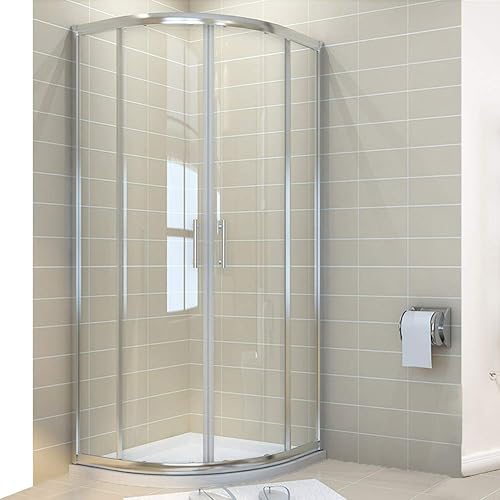
The enclosure type is usually dictated by the bathroom layout rather than preference. A quadrant enclosure works well in a corner where both walls are adjacent — the ELEGANT Quadrant Shower Enclosure 900mm is a solid entry-level option with 6mm safety glass and a reversible door that accommodates both left and right-hand configurations. For a more open feel in a larger bathroom, a walk-in panel with a deflector removes the need for a door mechanism entirely, which cuts down on maintenance.
Check the glass thickness before buying. 6mm is acceptable for a standard domestic enclosure; 8mm gives a more solid, premium feel with less flex. Nano or Easy Clean coatings applied to the glass surface reduce limescale adhesion, which is especially worth having in hard water areas.
Tray height is often overlooked. Low-profile trays (40mm or less) remove the need for a step and suit households where mobility may be a consideration. Confirm the sub-floor depth is sufficient to accommodate the waste trap if specifying an ultra-low-profile tray in a ground-floor or concrete-slab situation.
Thermostatic Shower Mixers
A thermostatic shower mixer maintains a set water temperature regardless of fluctuations in supply pressure or temperature from elsewhere in the system. This matters both for comfort and for safety, and under Part G of the Building Regulations, thermostatic control to limit outlet temperature to 48°C is required in new dwellings.
The Grohe Grohtherm 1000 Thermostatic Shower Mixer is a widely specified two-handle bar valve with a separate temperature and flow control — the layout is intuitive and suits both concealed and surface-mount installations. For a step up in functionality, the Hansgrohe Ecostat Thermostatic Shower Mixer adds Hansgrohe’s Select button technology, allowing push-button start and stop without altering the temperature setting.
Both require a balanced hot and cold supply to operate correctly. On a gravity-fed system with low pressure, check the minimum operating pressure specification before ordering — most thermostatic valves need at least 0.1 bar, with better performance at 1 bar and above.
Electric Showers
Where a gravity-fed hot water supply is inadequate or where the bathroom is remote from the cylinder, an electric shower is the practical answer. It draws cold mains water and heats it on demand, independently of the central heating system.
Power rating determines the flow rate at a usable temperature: a 9.8kW unit such as the Mira Sport Electric Shower 9.8kW will deliver a stronger shower than a 7.5kW model in the same conditions. Confirm the electrical supply can support the load — a 9.8kW shower typically requires a dedicated 40A or 45A circuit from the consumer unit. Connection and commissioning of an electric shower must be carried out by a Part P-registered electrician.
WC Choices: Wall-Hung vs Standard Close-Coupled
The choice between a wall-hung and a floor-standing WC is partly aesthetic, partly practical. Wall-hung pans lift the WC off the floor, simplifying cleaning and giving the illusion of more floor space. They require a concealed cistern frame built into a studwork or pre-built housing unit.
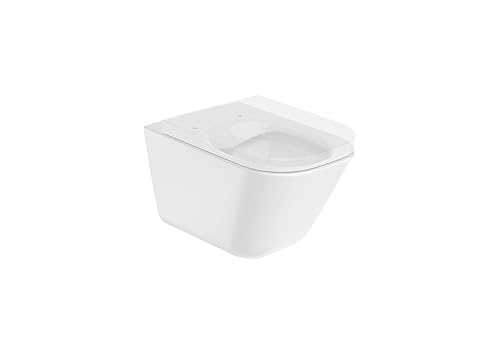
The Roca The Gap Rimless Wall Hung WC pairs with a suitable frame — the Grohe Rapid SL WC Frame is a well-regarded option that accommodates pans from most manufacturers and adjusts to suit floor-to-ceiling height. Rimless pan designs have become the norm because they eliminate the ledge that harbours bacteria, making cleaning significantly easier.
A soft-close toilet seat is a straightforward upgrade worth specifying on any WC. The SA Products Soft Close Toilet Seat is an economical option that retrofits to most standard pan fixings, with a quick-release mechanism for cleaning.
For floor-standing close-coupled WCs, ensure the pan-to-cistern connection is properly seated and that the flush valve rubber is checked during installation — a poorly seated valve will cause a continuous trickle that is both wasteful and audible.
Vanity Units and Basins
A vanity unit combines a basin with under-counter storage, and it is consistently one of the more requested bathroom upgrades. Floor-standing units with a soft-close drawer are the practical choice for most family bathrooms. The Nuie Vault Vanity Unit with Basin is a well-specified unit available in various widths, with a pre-drilled basin and integrated overflow — it reduces the number of separate components to source and coordinate.
In a cloakroom where space is limited, a compact semi-recessed or wall-mounted basin keeps the floor visible and the room feeling larger. The Vitra S20 Cloakroom Basin is a well-proportioned option in a small format, suitable for a single central tap hole.
Basin taps should be matched to the water pressure available. The Ideal Standard Concept Air Basin Mixer Tap is a quality mixer with a ceramic disc cartridge, but confirm whether it is specified for high or low pressure — some mixer taps are not suitable for gravity-fed supplies without an inline pressure-balancing kit.
Towel Rails and Bathroom Radiators
A heated towel rail serves a dual purpose: it keeps towels dry and contributes to the bathroom heat load. Chrome ladder-style towel rails are the standard choice and suit most bathroom styles. The Milano Chrome Heated Towel Rail is a straightforward central heating-fed option available in a range of heights and widths, and its BTU output should be checked against the calculated heat loss for the room.
For a less utilitarian look, a flat-panel or wave-pattern designer radiator gives a stronger visual statement. The Hudson Reed Revive Designer Radiator is a vertical radiator with a strong output relative to its footprint, which suits narrow wall spaces where a horizontal rail would not perform adequately.
Where central heating-fed rails are not practical — for example, in an en-suite added to a room remote from the heating circuit — a dual-fuel towel rail with an electric element allows use during the summer months when the boiler is not running.
For a simpler accessory rail not connected to the heating system, the Croydex Flexi-Fix Towel Rail installs without drilling by gripping to the tile surface — a useful solution in rented properties or where drilling is not practical.
Extractor Fans
Building Regulations Part F requires mechanical ventilation in rooms with no openable window, and it is best practice in any bathroom regardless. A continuously running extract fan or one with a humidistat and timer significantly reduces condensation and the associated mould risk.
The Envirovent SIL100T Silent Extractor Fan operates at a very low noise level — a significant selling point for bathrooms adjacent to bedrooms — and includes a built-in timer that continues extraction for a programmable period after the light is switched off. The duct diameter and run length affect performance; always check the manufacturer’s airflow curves against your installation conditions rather than simply comparing stated noise figures.
Accessories and Finishing Details
Accessories such as toilet roll holders, robe hooks, and shelving are often selected on aesthetics alone, but coordinating finishes across all hardware in a bathroom gives a professionally finished result. Brushed brass and matte black have become increasingly popular alternatives to chrome, and most major manufacturers now offer their accessory ranges in these finishes.
Check fixings on every accessory before installation. In a tiled wall, a hollow-wall fixing is not appropriate for a heavily loaded item such as a grab rail or a large mirror. Use a proper tile anchor and screw into any available stud where load demands it.
Taking the time to co-ordinate specifications across sinks, taps, enclosures, sanitaryware, and heating at the outset saves the significant inconvenience of mismatched finishes, incorrect fixing centres, and incompatible pressure requirements once work has started.