Why Site Equipment and PPE Matter
On a working site, the right kit keeps you safe, productive, and on the right side of health and safety regulations. PPE is not optional — under UK law, employers must provide appropriate personal protective equipment, and self-employed tradespeople are equally responsible for their own protection. Beyond the legal obligation, the right gear simply makes the job easier. This guide covers the essentials: what to look for and where not to cut corners.
Safety Boots
Safety boots are the single most important piece of PPE for most site workers. Look for the following ratings on the label:
- S1P or S3 — S3 is the standard for most outdoor and wet conditions, adding a penetration-resistant midsole and water resistance to the S1 base specification
- Toecap material — Steel is heavier but cheaper; composite (non-metallic) is lighter and better for sites requiring metal detector access
- Midsole protection — A penetration-resistant midsole (marked P) protects against nails and sharp debris underfoot
- Ankle support — Mid-cut or high-cut boots provide better ankle stability on uneven ground
The DeWalt Titanium S3 Safety Boots are a solid choice for tradespeople who spend long days on their feet — they combine composite toecap protection with cushioned footbeds that hold up through a full shift.
Safety Helmets
Hard hats are mandatory on most construction sites. The key distinction to understand is between the two main EN standards:
- EN 397 — The traditional industrial safety helmet. Protects against falling objects from above.
- EN 12492 — Mountaineering-style helmet with multi-directional impact protection. Required on some specialist sites.
Look for helmets with a ratchet adjustment for a secure fit, and consider vented models for summer work. The JSP EVO2 Vented Safety Helmet is widely used across the UK trade sector — it is lightweight, adjustable, and accepts a range of accessories including ear defenders and visors.
Helmets should be replaced after any significant impact, even if no visible damage is apparent. Check for cracks and UV degradation regularly; most manufacturers recommend replacing helmets every three to five years regardless of condition.
Eye Protection
Eye injuries are among the most common site accidents and are almost entirely preventable. Safety spectacles are the minimum for most work; goggles are required when working with liquids, grinding, or overhead cutting.
Look for the EN 166 mark, which confirms conformity with European safety spectacle standards. An optical class rating of 1 indicates minimal distortion — important for precision work. Anti-scratch and anti-fog coatings extend the working life significantly.
The Uvex Pheos Safety Spectacles offer wraparound coverage, UV protection, and a comfortable fit that makes them easy to keep on throughout the day — which is the whole point.
Ear Protection
Sustained exposure to noise above 85dB causes permanent hearing damage. Power tools, compressors, and site machinery routinely exceed this level. UK law requires employers to provide hearing protection at 85dB and above.
The two main formats are:
- Ear defenders (earmuffs) — Over-ear cups that are easy to put on and take off; suited to intermittent noise exposure
- Ear plugs — Disposable or reusable; better for all-day wear where defenders are impractical
The SNR (Single Number Rating) indicates how much sound is attenuated. An SNR of 30dB is appropriate for most site work. The 3M Peltor X4A Ear Defenders deliver an SNR of 33dB with a low-profile cup design that sits comfortably under a hard hat.
Workwear and Trousers
Trade trousers need to withstand abrasion, repeated kneeling, and constant movement. Key features to look for:
- Stretch panels — Kneeflexzone or gusset construction allows a full range of movement
- Knee pad pockets — Essential if you spend time on your knees; check the pocket accepts your preferred knee pad size
- Reinforced areas — Seat, knees, and hem are the highest-wear zones
- Pocket layout — Rule pockets, phone pockets, and holster pockets each serve a purpose; more is not always better if the pockets get in the way
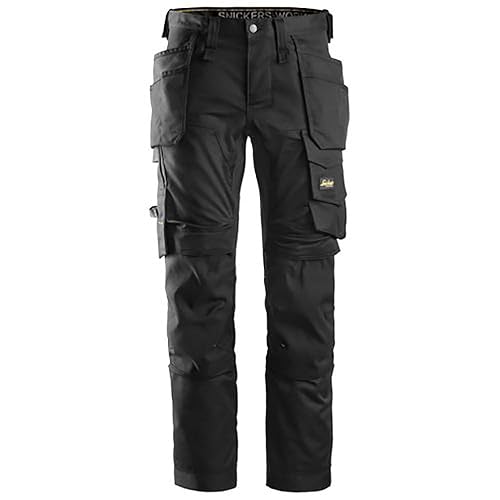
The Snickers 6241 AllroundWork Stretch Trousers are widely regarded as the benchmark for trade trousers — well-made, long-lasting, and genuinely comfortable for all-day wear. The Scruffs Trade Flex Work Trousers offer similar functionality at a lower price point and are worth considering if budget is a factor.
Hi-Vis and Knee Pads
Hi-vis vests and jackets are mandatory on most civil engineering, highway, and rail sites and increasingly common on all construction sites. The EN ISO 20471 standard defines three classes based on the quantity of reflective material — Class 2 is the minimum for most site work.
The Portwest S476 Hi-Vis Executive Vest is a step up from basic vests, with a zip front and a cleaner fit that works under jackets.
For knee protection, the DeWalt DWC15001 Professional Knee Pads use a gel insert and a hard shell cap, which is the right combination for prolonged kneeling on hard surfaces. Foam-only pads compress quickly and offer little protection after the first few hours.
Ladders
Step ladders and extension ladders are among the most frequently involved pieces of equipment in site accidents. Always check the load rating (EN 131 for professional use) and never use a domestic-rated ladder on a commercial site.
For step ladders, fibreglass models are safer around electrical work as they do not conduct electricity. The Werner Fibreglass Step Ladder (6 Tread) is rated to 150kg, meets EN 131 professional standards, and is a sensible choice for electricians, plumbers, and decorators alike.
Inspect ladders before each use. Look for damaged rungs, cracked stiles, and worn feet. A ladder that is out of shape should be removed from service immediately.
Site Lighting and Radio
Adequate lighting is essential for safe working in low-light conditions. Battery-powered LED torches and site lights have largely replaced mains-dependent options for versatility. The Makita DML186 18V LED Torch runs on standard Makita LXT batteries and delivers strong output for inspection and close work.
A site radio is a low-priority item but a genuine morale boost on longer jobs. The Makita DMR115 DAB+ Jobsite Radio accepts 18V LXT batteries or mains power, offers DAB+ and Bluetooth, and is built to survive the site environment.
For mains-powered equipment, a drum-wound cable reel is a safer option than a coiled extension lead. The Brennenstuhl 25m Cable Reel should always be fully unwound before use to prevent overheating.
Measuring and Marking Tools
Accuracy on site starts with reliable measuring and marking equipment. The Bosch Professional GLL 2-15 G Green Laser Level projects horizontal and vertical lines across a room and is a practical tool for first and second fix work. Green beam lasers are significantly easier to see in bright conditions than red beam alternatives.
The OX Pro Chalk Line Reel remains one of the fastest ways to strike a straight line over long distances — useful for tiling, decking, and setting out. And a quality handsaw like the Bahco ERGO 22-inch Handsaw is still indispensable for cutting in confined spaces or finishing cuts where a power saw is overkill.
Tool Storage
Keeping tools organised on site reduces lost time and protects equipment. A well-specified tool bag rather than a loose pile means everything is where you left it. The Stanley FatMax Technician Tool Bag offers a rigid base, multiple external pockets, and a wide opening that allows easy access — more useful in practice than a rigid box for everyday site use.
First Aid
Every site should have a stocked first aid kit accessible to all workers. The HSE recommends minimum kit contents based on site size; for a small site or a van kit, the HSE Workplace First Aid Kit covers the basics. Check and restock the kit regularly — an empty kit is no use when it matters.
Summary
Build your site PPE kit around the non-negotiables first: rated safety boots, a compliant hard hat, eye and ear protection. Add workwear that will last, hi-vis for any site requiring it, and knee pads if your work demands them. From there, invest in tools that improve accuracy and organisation — a laser level, a reliable measuring kit, proper storage — and make sure lighting and first aid are never an afterthought.