Good workwear does more than keep you warm or look professional. It protects you from injury, reduces fatigue over a long shift, and in some cases keeps you legal on site. This guide covers the key categories — trousers, boots, helmets, eye protection, ear protection, hi-vis, and knee pads — and explains what to look for when buying each one.
Work Trousers
Work trousers take more punishment than almost any other garment on site, so build quality and fit should be your first considerations.
Fit and Mobility
Traditional work trousers were cut loose to allow movement, but this often meant excess fabric catching on edges or getting in the way. Modern trade trousers have moved towards a more tailored cut with stretch panels built into the knees, back rise, and crotch. These let you move freely without the bulk. If you spend a lot of time on ladders, reaching overhead, or working in confined spaces, a pair with mechanical stretch fabric will make a noticeable difference by the end of the day.
Knee Pad Pockets
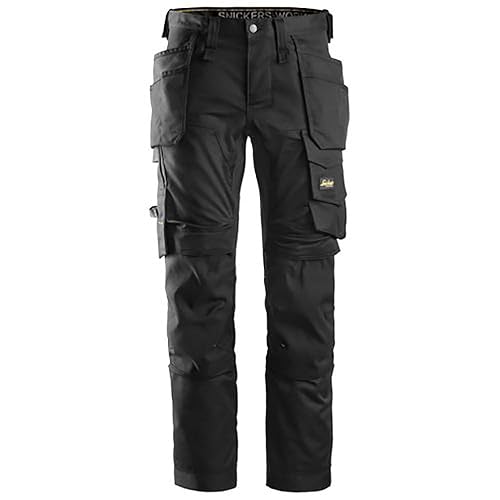
Most quality work trousers now include pockets for integrated knee pads. Check that the pockets are the right size for your knee pads before buying — some brands use a proprietary sizing that only works with their own pads. Ideally, the pocket should hold the pad firmly without it shifting when you kneel or stand.
Snickers vs Scruffs
These two brands dominate the UK trade trouser market at the mid-to-premium end.
The Snickers 6241 AllroundWork Stretch Trousers are a benchmark product. They use a four-way stretch fabric, have reinforced knees, and include well-positioned tool and phone pockets. The cut suits most builds and they hold their shape through repeated washing. The price reflects the quality, but many tradespeople buy one pair and find they outlast cheaper alternatives several times over.
The Scruffs Trade Flex Work Trousers offer a similar stretch-panel design at a lower price point. They are a solid choice if you go through trousers quickly due to the nature of your work, or if you want a second pair for less demanding days. The fabric is slightly lighter than Snickers, which suits warmer weather.
Safety Boots
Foot protection is one area where buying cheap can have serious consequences. Beyond the basic requirement for steel or composite toe caps, there are meaningful differences between safety ratings and boot constructions.
S1P vs S3
Safety boots sold in the UK are rated to EN ISO 20345. The two ratings you will encounter most often are S1P and S3.
S1P boots have a toe cap, anti-static properties, and a penetration-resistant midsole. They are suitable for most general site environments.
S3 boots add a waterproof and water-resistant upper to the S1P requirements. If you work outdoors regularly, on wet sites, or in conditions where your feet are likely to get wet, S3 is the practical minimum.
Composite vs Steel
Steel midsoles and toe caps are the traditional choice and generally cost less. Composite alternatives — typically made from fibreglass or Kevlar — are lighter and do not conduct heat or cold. On a cold winter site, composite boots will feel noticeably warmer. They also pass through metal detectors, which matters if you work on certain secure sites.
The DeWalt Titanium S3 Safety Boots are a well-regarded option at the S3 rating. They offer a robust waterproof upper, composite midsole, and enough ankle support for working on uneven ground.
Ankle Support
If your work involves rough terrain, scaffolding, or carrying heavy loads, look for a boot with a higher ankle collar and good lateral support. Low-cut safety trainers are fine for flat warehouse or workshop environments but offer little protection against rolled ankles on a typical building site.
Safety Helmets
Most sites require a helmet meeting EN 397. Look for a helmet with a comfortable internal harness and a ratchet adjustment — these are far quicker to fit correctly than pin-and-clip systems, which matters when you are putting it on and off repeatedly.
Vented helmets are noticeably cooler in summer but some site rules require non-vented lids in environments where falling particles or chemical splash is a risk. If you work across varied sites, a vented model is usually the right default.
The JSP EVO2 Vented Safety Helmet is widely used across UK construction. It has a well-designed harness, accepts a range of accessories including ear defenders and visors, and is available in the colours required by most site hierarchies.
Eye Protection
Safety spectacles are a legal requirement in many site environments and a sensible precaution in almost all of them. The key standard to look for is EN 166. Lenses marked 1 on the optical class provide the best optical clarity — worth paying for if you wear them for extended periods.
Anti-scratch and anti-fog coatings make a practical difference. A lens that fogs up every time you move from a cold area to a warm one will end up in your pocket rather than on your face.
The Uvex Pheos Safety Spectacles combine good optical quality with a wraparound lens that provides coverage against flying debris from the sides, and are comfortable enough to wear for a full day.
Ear Protection
Prolonged exposure to noise above 80 dB(A) triggers legal duties under the Control of Noise at Work Regulations. Ear defenders should meet EN 352-1 and carry an SNR (Single Number Rating) value — the higher the SNR, the greater the attenuation.
For most site use, defenders with an SNR of around 30 dB are appropriate. Over-attenuation can be a hazard in itself, as it prevents you from hearing warnings or communication.
The 3M Peltor X4A Ear Defenders have an SNR of 33 dB and a low-profile cup design that works well under a helmet. The headband tension holds them securely without becoming uncomfortable over a long shift.
Hi-Vis Clothing
Hi-vis garments are rated under EN ISO 20471, which defines three classes based on the amount of fluorescent and reflective material.
- Class 1 is the minimum — small vests suitable for low-traffic environments.
- Class 2 is the most common requirement on building sites and road works.
- Class 3 provides the highest visibility and is required on motorway and high-speed road environments.
Always check the class required by the specific site or contract before buying. A Class 2 vest may not be accepted where Class 3 is specified.
The Portwest S476 Hi-Vis Executive Vest meets Class 2 requirements and has a neater cut than standard hi-vis, with multiple pockets and a zip front. It is a practical choice for site managers and trades who want something that looks presentable during client visits as well as on the tools.
Knee Pads
Gel vs Foam
Gel knee pads distribute pressure more evenly and tend to perform better on hard surfaces such as concrete or tile. Foam pads are lighter and often preferred for tasks where you are moving between kneeling and standing frequently. Hard-shell pads add a layer of impact protection on top of the cushioning, which is worth having if you work around sharp debris.
The DeWalt DWC15001 Professional Knee Pads use a gel insert with a hard outer cap and an adjustable strap system that keeps them positioned correctly without cutting off circulation — a common complaint with cheaper pads.
Seasonal Considerations
Summer workwear should prioritise breathability and UV protection. Lightweight ripstop fabrics and mesh-lined trousers make a significant difference in hot weather. Many tradespeople keep a lighter pair of trousers for summer and a heavier cordura-reinforced pair for winter.
In cold weather, layering is more effective than a single heavy outer garment. A base layer that wicks moisture, a mid-layer fleece, and a wind and waterproof outer shell gives you flexibility as you move between heated and unheated areas. Insulated safety boots and thermal socks are worth the investment if you work outdoors through winter.
Waterproofs should be a permanent part of your kit regardless of season. A packable waterproof jacket takes up almost no space and will be needed more often than you expect.