Which Screw for Which Job?
Using the wrong screw costs time — stripped heads, split timber, premature corrosion, or a fixing that simply is not strong enough for the application. This guide covers the main screw types used in construction and joinery, when to use each, and what to keep in stock.
Woodscrews (General Purpose)
Standard woodscrews have a coarse, single-start thread, countersunk head, and are available in zinc-plated, yellow zinc, or hardened steel. They are appropriate for:
- Fixing timber to timber in general carpentry and joinery
- Fixing hinges, brackets, and ironmongery
- Fixing into MDF and sheet materials (pilot drilling recommended in MDF to prevent splitting near edges)
Thread type matters: Twin-start threads pull faster and resist cam-out better than single-start. Many modern woodscrews also feature a serrated or ribs underhead to reduce surface breakout in timber.
Partial thread vs full thread: A partially-threaded screw has a smooth shank below the head. The threaded section grips the receiving material; the smooth shank in the face material allows the head to pull the two pieces together. Fully-threaded screws pull through the face material and can prevent good clamping. For most timber-to-timber applications, use partially-threaded screws of appropriate length.
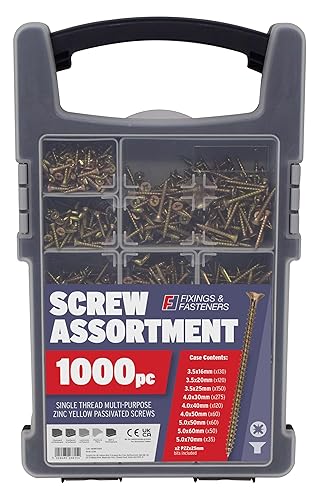
The Timco Solo woodscrew mixed tray covers most general joinery requirements across common sizes. For volume purchasing in a specific size, the Reisser R2 cutter woodscrew tub is a consistently reliable option — the R2’s cutting ribs under the head reduce surface splitting and the Reisser thread profile provides excellent pull-out.
Drywall Screws
Drywall screws are designed for one job: fixing plasterboard to timber or metal studwork. Key features:
- Fine thread for metal stud; coarse thread for timber stud
- Bugle head — the tapered underhead pulls the board tight without tearing the paper face
- Sharp point for quick penetration
- Phosphate finish (grey/black colour) — not corrosion resistant; not suitable for external or damp conditions
Critical limitation: drywall screws are brittle. They are case-hardened and designed to snap rather than bend under load. They must not be used as structural fixings in timber framing, stair components, or load-bearing connections. Using drywall screws as general-purpose timber screws is a common and potentially dangerous mistake.
Standard sizes: 3.5 x 35mm for 12.5mm board to timber, 3.5 x 42mm for 15mm board or two-layer systems.
Decking Screws
Decking requires screws that resist corrosion in permanent outdoor exposure, pull flush with the board surface without pre-drilling, and do not split the board.
Key features to look for:
- Corrosion resistance: Use A4 stainless steel, hot-dip galvanised, or a specifically rated polymer coating for treated softwood. Standard zinc plate corrodes rapidly in external conditions, especially in contact with timber treatment chemicals.
- Countersinking tip: A sharp countersink point allows the head to seat without pre-drilling in most softwood decking.
- Auger tip: Some decking screws have a double-start auger tip to reduce splitting at board ends — useful in hardwood and pre-dried softwood.
- Diameter: 4.5–5.0mm is standard for decking boards. Thinner screws have insufficient shear strength for decking fixing loads.
Length should be approximately 2.5–3x the board thickness: for 32mm boards, use 80–90mm screws; for 22mm boards, 65–70mm.
For composite decking, use screws specified by the decking manufacturer — many composites have specific requirements or use hidden clip systems.
Frame Fixings and Coarse Thread Screws
Frame fixings (also called frame screws or coarse thread screws) are large-diameter screws for fixing timber frames, battens, and structural elements into masonry or dense substrates. They require a pre-drilled and plugged hole in masonry, or drive directly into timber at high load.
Features:
- Typically 7.5–8.0mm diameter
- Coarse, high-lead thread for fast penetration
- Hex head or countersunk
For fixing treated timber to masonry (e.g., treated sole plate, battens for external cladding), use stainless steel or galvanised frame fixings. Zinc-plated fixings corrode in contact with treated timber in external or semi-exposed conditions.
Structural Screws
For structural timber connections (joist hangers, timber-to-timber load-bearing joints, post bases, LVL connections), dedicated structural screws with published characteristic values are required. These differ from standard woodscrews in thread geometry, core diameter, steel grade, and coating.
Key brands in this category include Reisser Rapid, Spax Wirox, Timco Shield, and Heco. Each publishes ETA (European Technical Assessment) values for shear, pull-out, and withdrawal strength, enabling structural calculations to be carried out and verified.
Do not use general woodscrews in place of structural screws in load-bearing applications — the characteristic values are not established and the design cannot be verified.
Stainless Steel Screws: A2 vs A4
When corrosion resistance is required, the grade matters:
A2 stainless steel (304 grade) — suitable for most outdoor applications away from the coast, in treated timber, and in non-aggressive environments. A2 is the minimum grade for external decking, cladding battens, and fencing in inland locations.
A4 stainless steel (316 grade, marine grade) — required in coastal environments (within a few kilometres of the sea), in swimming pool enclosures, and in high-chloride environments. Also used for fixing hardwood decking where the higher tannin content would react with A2 fasteners.
The cost premium of A4 over A2 is relatively small per screw — always specify A4 in coastal locations.
Screw Coatings
When stainless steel is not required, coatings provide corrosion protection for standard carbon steel screws:
- Yellow/bright zinc plate — indoor use only. Minimal corrosion resistance. Standard for internal joinery and general interior use.
- Hot-dip galvanised — provides substantial corrosion resistance for external use. Can be used in contact with most treated timber.
- Polymer-coated (e.g., Ruspert, Geomet) — treatment-rated coatings designed specifically for use with UC3/UC4 preservative-treated timber. Check the screw manufacturer’s compatibility statements.
Never use standard bright zinc-plated screws in treated timber for external applications — the preservative chemicals accelerate zinc corrosion, and the fixing will fail.
Drive Types
Pozi (PZ) — the traditional standard for UK woodscrews. Two-wing cross recess with angled flanks. Susceptible to cam-out under high torque, particularly in impact drivers.
Torx (TX/6-lobe star) — now the dominant drive for trade screws. The six-lobe profile provides higher torque transmission, dramatically reduced cam-out, and better bit engagement at any angle. Torx is the practical choice for impact driver use.
Hex head — for frame fixings and structural screws where a socket driver is preferred. Very high torque without cam-out risk.
Length and Gauge: Rules of Thumb
- General timber joinery: screw length = 2.5–3x the thickness of the material being fixed through
- Into end grain: increase length by 50% and consider using a different fixing — end grain pull-out is poor
- Plasterboard to timber: 32mm board minimum penetration into stud
- Decking: 65–90mm depending on board thickness
- Structural connections: follow ETA values for the specific product
What to Stock
For a well-stocked van or site box, a mixed tray covering the most common sizes (3.5mm and 4.0mm in 25, 35, 50, 75mm lengths) handles the majority of general joinery work. Supplement with dedicated tubs of drywall screws (coarse and fine thread), a selection of A4 stainless decking screws, and a tub of frame fixings. Having the right screw immediately available is faster and more professional than substituting whatever is closest.