Consumer Units and Circuit Protection
The consumer unit is the heart of any domestic electrical installation. In the UK, all new or replacement consumer units must comply with the 17th and 18th Edition Wiring Regulations (BS 7671) and, crucially, be housed in a non-combustible enclosure. The Hager Design 10 VML106 Metal Consumer Unit is a well-regarded choice among electricians — its metal enclosure meets the non-combustible requirement, and it offers a clean split-load arrangement suited to modern domestic installs.
MCBs vs RCBOs
The shift from standard MCBs on shared RCD protection to individual RCBOs on each circuit is now the recommended approach for new installations. RCBOs combine overcurrent and residual current protection in a single device, which means a fault on one circuit trips only that circuit rather than taking down half the board.
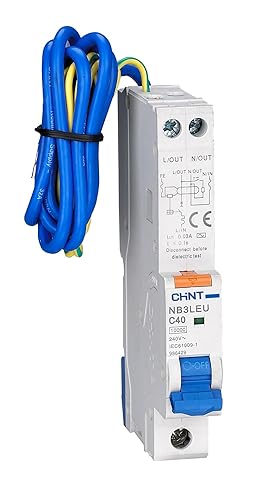
For a radial socket circuit, the Chint NB3LEU RCBO 16A Type B 30mA Type A provides solid protection at a competitive price point. Type A devices handle pulsating DC fault currents, making them the correct choice wherever switch-mode power supplies and EV chargers may be in use. For a dedicated 20A circuit — a shower pump or larger radial, for instance — the Wylex NHXS1B20 RCBO Type B 20A is a reliable option from an established UK brand. Lighting circuits typically carry lower loads; a Schneider Electric Easy9 MCB Type B 6A will protect a standard lighting circuit where it sits behind an upstream RCD.
When specifying protective devices, always confirm compatibility with the consumer unit manufacturer — some units are designed for their own branded devices only.
Fire-Rated Downlights
In any floor or ceiling that forms a fire-separating element, downlights must be fire-rated to maintain compartmentation. The standard requirement is 30 or 60 minutes’ fire integrity, and most fire-rated downlights achieve this with an intumescent pad that expands and seals the aperture when exposed to heat.
The Luceco FType MK2 CCT Fire Rated LED Downlight is a widely used choice on domestic projects. Its switchable colour temperature (warm white, neutral, or cool white selectable at the fitting) means a single SKU covers multiple rooms, and the push-fit connector simplifies installation. The Collingwood H2 Lite T Fire Rated LED Downlight is another strong option, particularly popular where a low-profile fitting is needed in a shallow ceiling void. For a more budget-conscious install where GU10 lamps are preferred, the Aurora Enlite Fire Rated GU10 Downlight accepts standard GU10 bulbs and still meets the necessary fire-rating requirements.
Key points to check before specifying any downlight:
- Confirm the fire-rating duration matches the floor/ceiling specification
- Check the minimum ceiling void depth — some fittings require 60mm or more
- Verify IP rating if the fitting is in a bathroom zone
- Ensure the driver or lamp is dimmable if the circuit will be controlled by a dimmer
Smart Lighting
Smart lighting has moved from a novelty to a practical upgrade, particularly in residential new builds and refurbishments. The Philips Hue Essential Starter Kit provides a straightforward entry point: the bridge connects to the home router, and the E27 bulbs can be controlled via app or voice assistant from day one. For clients who want smart capability without the colour-changing features, the Philips Hue White E27 Starter Kit offers the same platform at a lower cost.
Smart lighting systems require a neutral wire at the switch position in most installations — worth factoring in during first-fix when it costs very little to add.
For external areas, smart security lighting is increasingly requested. The Ring Floodlight Cam Wired Plus combines a PIR-triggered floodlight with an integrated camera, wiring directly into a suitable circuit via a fused spur. The Timeguard FST24 Fused Spur Timer is a practical choice for controlling external lighting on a fixed schedule where a smart system is not required — the integral fused spur simplifies the installation considerably.
Sockets and Switches
Specifying the right socket and switch range can define the finish of a whole project. Metal-clad finishes have grown significantly in popularity for premium residential work. The BG Electrical Nexus Metal Double Socket is a reliable choice in brushed steel — robust enough for everyday use and well regarded by installers for its ease of wiring.
When wiring sockets and connections inside the consumer unit, lever-type connectors have largely replaced traditional chocolate-block terminals in quality installs. The Wago 221 Series Lever Connector Box is the standard go-to: tool-free, reusable, and suitable for solid and stranded conductors up to 4mm². They are accepted as a permanent connection method under BS 7671 when enclosed appropriately.
Test Equipment
No electrical installation should be handed over without the relevant tests being carried out and recorded. For a first-fix and second-fix electrician, two instruments cover most day-to-day requirements.
The Fluke T110 Voltage and Continuity Tester is a compact, robust non-contact and contact tester used for confirming live/dead status before working on circuits. Its clear indication and CAT III 600V rating make it appropriate for domestic and light commercial work. For verifying socket installations, the Martindale EZ150 Socket Tester gives an instant indication of correct wiring, reversed polarity, and missing earth — a quick check that should be routine on every socket at second fix.
Before chasing walls or drilling, a cable and pipe detector is essential. The Bosch Professional GMS 120 Cable Detector detects live cables, metal pipes, and wooden joists — a reliable first check before any invasive work.
Hand Tools for Electrical Work
The quality of hand tools matters when working on electrical installations. VDE-rated tools are tested to 1000V and are the minimum standard for any tool used near live conductors. The Wera Kraftform VDE Screwdriver Set is a popular choice among electricians for its comfortable grip and precise blade tips — correctly fitting terminals and avoiding stripped screws is far more important than it might seem on a busy installation. For gripping and cutting cable, the Knipex VDE Pliers Set offers the combination and side-cutting pliers that most electricians reach for daily.
Summary
A quality domestic electrical installation comes down to specifying compliant, well-matched components at every stage — from the consumer unit and circuit protection through to the fittings, switches, and the tools used to install them. Prioritise RCBOs over shared RCD protection, specify fire-rated downlights wherever compartmentation applies, and never skip post-installation testing. Getting those fundamentals right produces an installation that is safe, certifiable, and built to last.